7 Important Connections Between Diabetes and Joint Pain: What Patients Should Know
Diabetes and Joint Pain may seem like two completely separate
Diabetes and Joint Pain may seem like two completely separate health problems. One involves blood sugar, while the other involves bones, muscles, joints or nerves.
But the human body does not work in separate compartments. Changes associated with diabetes can affect nerves, circulation, connective tissues and movement — and these changes may contribute to pain, stiffness or difficulty moving.
One well-known example is frozen shoulder, which is more common in people with diabetes. Diabetes can also cause nerve damage, particularly in the feet and legs, which may produce burning, tingling, numbness or pain.
So, if you have diabetes and have started experiencing unexplained body or joint pain, it is worth looking beyond the joint itself. 👀
Let us understand the connection.
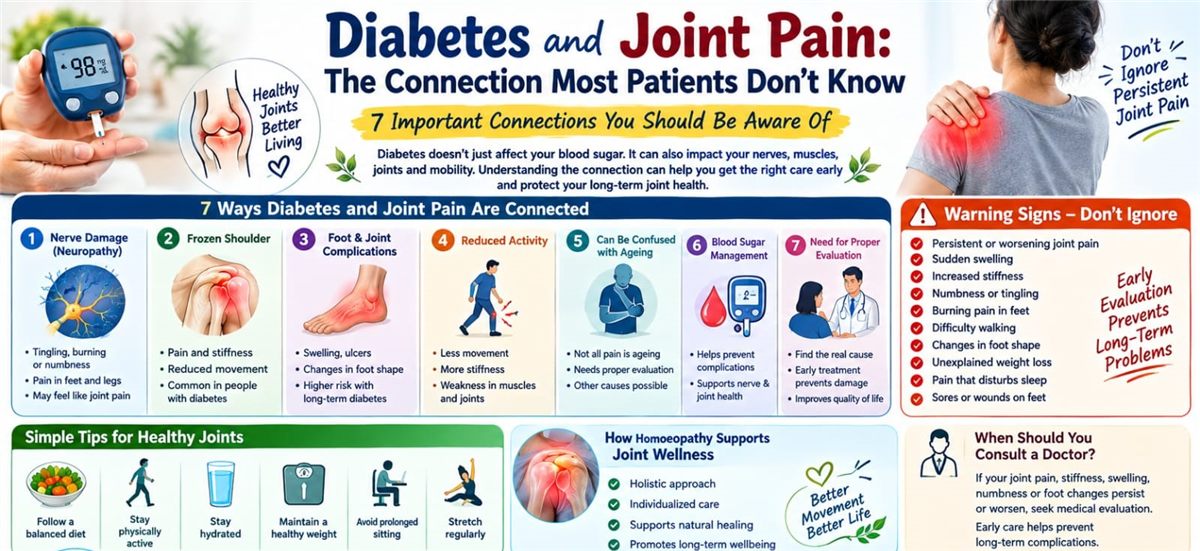
1. Diabetes and Joint Pain Can Be Linked Through Nerve Damage 🧠
One of the important complications associated with diabetes is diabetic neuropathy, or diabetes-related nerve damage.
When blood sugar remains high over time, nerves can become damaged. Peripheral neuropathy commonly affects the feet and legs and may cause:
– Tingling or “pins and needles”
– Burning sensations
– Numbness
– Increased sensitivity
– Pain
– Weakness
Sometimes patients describe this discomfort simply as “joint pain” because the pain may be felt around the feet, ankles or legs. Also read ✋ Tingling in Fingers: Could It Be Carpal Tunnel Syndrome?
Diabetes and Joint Pain: Why Location Matters
If pain is accompanied by burning, tingling or numbness, the problem may not be coming from the joint alone.
This is why a proper clinical assessment is important.
2. Diabetes Can Increase the Risk of Frozen Shoulder 🦴
Diabetes and Joint Pain have another important connection: frozen shoulder.
Frozen shoulder, also called adhesive capsulitis, causes pain and progressive stiffness in the shoulder. Everyday movements such as reaching overhead, putting on clothes or reaching behind the back may become difficult.
Diabetes is associated with a higher likelihood of developing frozen shoulder. The exact reason for this association is not completely understood.
Diabetes and Joint Pain: Frozen Shoulder Symptoms
Watch for:
– Gradually increasing shoulder pain
– Shoulder stiffness
– Difficulty lifting the arm
– Difficulty reaching behind the back
– Pain that may disturb sleep
– Increasing restriction in everyday movements
If your shoulder is becoming progressively stiff rather than simply painful, don’t ignore it. 🩺
3. Long-Term Diabetes Can Affect the Feet and Joints 👣
The feet deserve special attention in people living with diabetes.
Diabetes-related nerve damage can reduce sensation in the feet. This means a person may not notice a small cut, blister, sore or injury.
Diabetes-related foot problems can also involve nerves, blood vessels and joints. The CDC specifically identifies neuropathy, arthropathic and vascular problems among diabetes-related foot conditions.
Diabetes and Joint Pain: Don’t Ignore Foot Changes
Pay attention to:
– New swelling
– Pain or numbness
– Changes in foot shape
– Changes in skin colour or temperature
– Sores or blisters
– Burning or tingling
– Difficulty walking
Foot problems in diabetes should be assessed promptly, particularly when there is numbness or an injury. 👣
4. Pain Can Make You Less Active — and That Can Affect Joint Health 🚶♂️
There is another connection that is easy to overlook.
When a person has persistent pain, they may naturally start moving less.
Less movement can lead to reduced strength, poorer mobility and difficulty performing normal activities. At the same time, avoiding movement because of pain may make some joints feel increasingly stiff.
This does not mean that every person with diabetes and joint pain should exercise in the same way.
The right level and type of activity depends on your overall health, the cause of the pain, your joints and any diabetes-related complications.
A healthcare professional can help you decide what movement is appropriate for you.
5. Diabetes and Joint Pain May Sometimes Feel Like “Normal Ageing” 👴👵
Many adults assume that joint pain is simply part of getting older.
But persistent pain should not automatically be blamed on age.
If someone with diabetes develops:
– New shoulder stiffness
– Repeated joint discomfort
– Burning feet
– Numbness
– Difficulty walking
– Reduced range of movement
– Unexplained weakness
the symptoms deserve proper evaluation.
There can be several possible causes, including joint conditions, nerve-related problems, injuries and other health issues.
The important point is simple: don’t assume that every pain is ordinary ageing.
6. Blood Sugar Management Is Part of the Bigger Picture 🩸
When discussing Diabetes and Joint Pain, it is important to remember that joint care cannot be completely separated from diabetes care.
The CDC notes that keeping blood sugar within an individual’s target range can help prevent or delay several diabetes complications, including nerve damage.
This does not mean that controlling blood sugar will automatically make every joint pain disappear.
Instead, diabetes management should be considered one important part of protecting long-term health.
Regular medical follow-ups, appropriate physical activity, healthy eating, weight management when appropriate and monitoring for complications all have a role in diabetes care.
7. Diabetes and Joint Pain Should Be Evaluated When Symptoms Persist 🔎
Not every joint pain in a person with diabetes is caused by diabetes.
This is a very important point.
A person with diabetes can still develop osteoarthritis, an injury, tendon problems, inflammatory conditions or other causes of pain.
Therefore, the goal is not to assume that diabetes is the cause.
The goal is to understand why the pain is happening.
Diabetes and Joint Pain: When Should You Seek Medical Advice?
Consider medical evaluation if you have:
– Persistent or worsening joint pain
– Sudden swelling
– Increasing stiffness
– Unexplained weakness
– Numbness or tingling
– Burning pain in the feet
– Difficulty walking
– A new change in foot shape
– A wound or sore on the foot
– Pain that repeatedly disturbs sleep
The CDC recommends prompt medical attention for concerning foot symptoms such as sores, infections, changes in foot colour or temperature, numbness, burning or pain.
Diabetes and Joint Pain: What Can You Do Every Day? 🌿
Living with diabetes does not mean you should expect joint problems.
Small, consistent habits can support overall health:
🥗 1. Follow a balanced eating pattern
Choose a balanced diet that fits your individual diabetes plan. Avoid making major dietary changes without considering your medical needs.
🚶 2. Stay appropriately active
Regular movement can support mobility, strength and overall health. However, choose activities appropriate for your joints and diabetes-related complications.
👣 3. Check your feet
People with diabetes should pay attention to their feet, especially when sensation is reduced. Regular foot checks can help identify problems early.
🩺 4. Keep your health appointments
Diabetes requires ongoing monitoring. Regular check-ups can help identify complications before they become more serious.
🧘 5. Don’t ignore persistent pain
Pain is information from your body. If it continues, changes or interferes with daily activities, find out why.
Can Homoeopathy Be Considered Alongside Overall Joint Health? 🌿
As a doctor practicing Homoeopathy, I believe every patient deserves an individual assessment rather than assuming that all joint pain has the same cause.
When a patient has diabetes along with joint pain, the complete health picture is important — including the duration of diabetes, current symptoms, medications, lifestyle, mobility and any nerve or foot-related symptoms.
Homoeopathy should not be used as a reason to ignore diabetes monitoring, medical evaluation or important complications.
The first step is always understanding the patient’s condition properly.
Final Thoughts on Diabetes and Joint Pain ❤️
Diabetes and Joint Pain can be connected in several ways, particularly through nerve damage, frozen shoulder and diabetes-related foot or joint complications.
But diabetes is not automatically the explanation for every painful joint.
If you have diabetes and notice persistent pain, stiffness, numbness, burning sensations or changes in your feet, don’t simply accept it as “normal.”
Listen to your body. 🩺
Early evaluation can help identify the possible cause and guide appropriate care.
Your joints deserve attention — and so does your overall health. 🌿
👨⚕️ Dr. Rajendra Shrimali, MD (Homoeo.)
Homoeopathic Consultant
🏥 Dr. Shrimali’s Homoeopathic Multispecialty Clinic
📍 1st Floor, Court Road, Kopargaon, Dist. Ahilyanagar (MH)
📞 Phone: 7666360940
📸 Instagram: @dr.rajendra_shrimali
Dr. Rajendra Shrimali, MD (Homoeo.)
Homoeopathic Consultant, Dr. Shrimali's Homoeopathic Multispecialty Clinic, Kopargaon.