7 Signs of Scoliosis in Teenagers Parents Often Miss
Scoliosis in Teenagers: Why Parents Should Know the Early
🦴 Scoliosis in Teenagers: Why Parents Should Know the Early Signs
Scoliosis in Teenagers can sometimes develop so gradually that parents do not notice it in the beginning.
A teenager may look perfectly healthy, play sports, attend school and carry on with normal activities. There may be no obvious back pain at all.
Yet, when they stand in front of a mirror or wear certain clothes, a parent may suddenly notice that one shoulder looks slightly higher than the other.
This is one of the reasons scoliosis can go unnoticed during the teenage years.
👀 The earlier a change in posture or spinal alignment is noticed, the sooner it can be properly assessed.
As a doctor practising Homoeopathy for the last 3 decades, I always encourage parents to pay attention to small physical changes in growing children. You don’t need to become anxious about every difference in posture. But unusual or persistent changes should not simply be ignored.
Let’s understand the signs in simple language.
🧠 What Is Scoliosis?
Scoliosis is a condition in which the spine develops an abnormal sideways curvature.
A healthy spine is not completely straight from every angle. When viewed from the side, it naturally has curves. However, scoliosis involves an abnormal sideways curve when looking at the spine from behind.
It may develop during childhood or adolescence.
In many teenagers, the exact cause is not identified. This is often referred to as idiopathic scoliosis.
Growth during adolescence can make spinal curvature more noticeable.
That is why the teenage years are an important time for parents to pay attention to changes in posture and body symmetry.
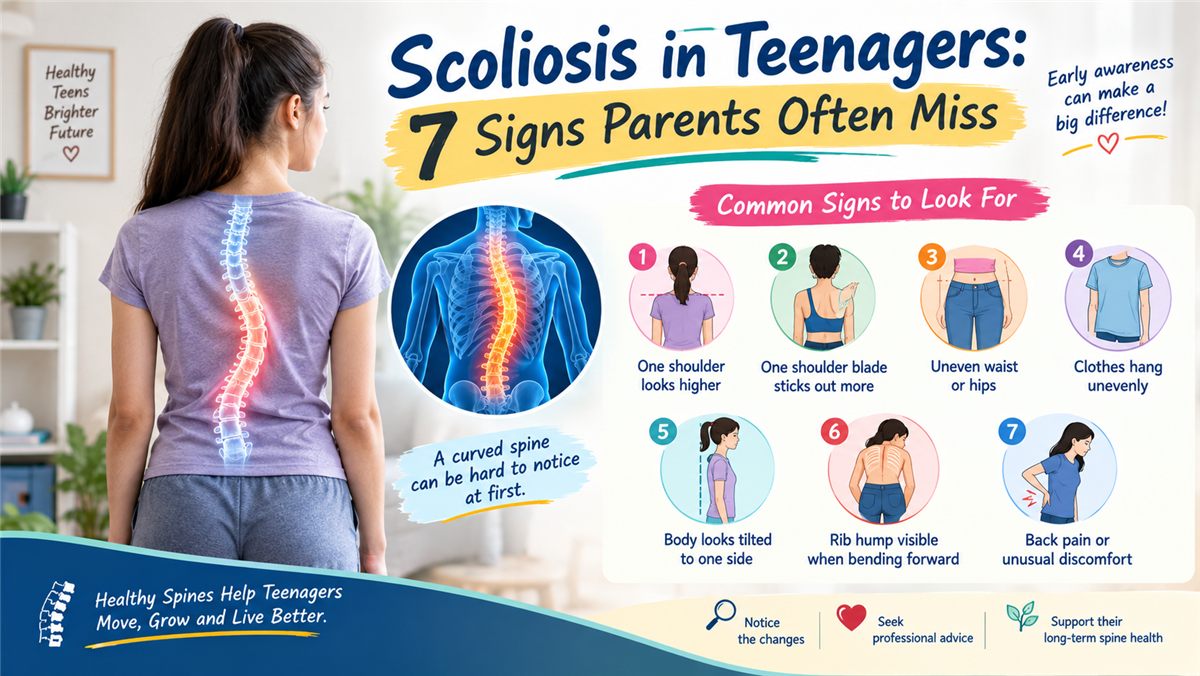
🔎 Scoliosis in Teenagers: 7 Signs Parents Often Miss
1️⃣ One Shoulder Looks Higher Than the Other
This can be one of the easiest signs to notice.
When your teenager is standing naturally, look at their shoulders.
Does one shoulder appear higher?
Does one shoulder seem to sit further forward?
A small difference does not automatically mean scoliosis. People naturally have some asymmetry.
But if the difference is persistent and noticeable, it is worth discussing with a healthcare professional.
👉 Try observing the posture without asking your child to deliberately straighten up.
2️⃣ One Shoulder Blade Sticks Out More
Another possible sign is uneven shoulder blades.
You may notice that one shoulder blade appears more prominent than the other.
This can become easier to see when the teenager bends forward.
Again, this does not mean that every uneven shoulder blade is scoliosis.
Muscle development, posture and other factors can also create differences.
But persistent asymmetry deserves attention.
3️⃣ Uneven Waist or Hips 👖
Take a look at the teenager’s waistline or hips when they are standing naturally.
You may notice:
- One side of the waist appears more curved.
- One hip looks higher.
- Clothes seem to hang differently on each side.
- One side of the body appears more prominent.
Parents sometimes notice this while helping their child choose clothes.
For example, you may think:
“Why does this shirt look slightly tilted on one side?”
Sometimes, this can simply be the way the clothing fits.
But if the same asymmetry is visible on the body itself, it may be worth getting checked.
4️⃣ Clothes Hang Unevenly
This is a surprisingly useful observation.
A teenager may repeatedly complain that:
👕 One side of a shirt sits differently.
👖 One trouser leg appears longer.
🎒 A backpack keeps slipping toward one side.
👗 A dress or top appears uneven around the shoulders or waist.
Clothing problems alone cannot diagnose scoliosis.
However, repeated unevenness may encourage parents to look more closely at posture and body symmetry.
🧍 Scoliosis in Teenagers Can Affect Posture
5️⃣ The Body Looks Tilted to One Side
Ask your teenager to stand comfortably and naturally.
Look at the overall body position.
Does the body appear to lean to one side?
Does the head seem slightly off-centre compared with the hips?
Does the teenager frequently stand with their weight shifted onto one leg?
Some teenagers simply have habitual posture patterns.
But if the same body tilt remains noticeable despite changing position, professional assessment may be useful.
6️⃣ A Rib Hump Becomes Visible When Bending Forward
One of the more noticeable signs can appear when the teenager bends forward.
Parents may see that one side of the back or ribs appears higher than the other.
This difference can sometimes be associated with rotation of the spine.
You should not try to diagnose scoliosis at home using this observation.
Instead, if you notice an unusual difference, mention it to a healthcare professional.
A proper assessment can determine whether the spinal alignment needs further evaluation.
7️⃣ Back Pain or Unusual Discomfort
Many teenagers with scoliosis may not have significant pain, particularly in the early stages.
However, some teenagers can experience back discomfort.
Pay attention if your child repeatedly complains about:
- Back pain after standing
- Discomfort after sitting for a long time
- Pain during certain activities
- Persistent back tiredness
- Recurrent discomfort without an obvious reason
Back pain in teenagers can have many causes.
Sports activity, muscle strain, prolonged sitting, backpacks and other factors can contribute.
So, back pain alone does not mean scoliosis.
But persistent pain combined with visible asymmetry deserves attention. Also read 🦴 5 Signs Your Back Pain Is Not Just Muscle Pain – Don’t Ignore These Warning Signs
📱 Why Can Scoliosis Be Missed in Teenagers?
Teenagers spend a lot of time sitting, studying, using phones, playing games and participating in sports.
Because posture naturally changes during these activities, parents may assume that an unusual posture is simply a result of:
📱 Phone use
💻 Computer work
🎒 Carrying a school bag
🏏 Sports
🪑 Long hours of sitting
Sometimes that may be true.
But persistent structural changes should not automatically be blamed on “bad posture.”
This is why observing your child’s overall posture and body symmetry can be useful.
🩺 How Is Scoliosis Evaluated?
If a doctor suspects scoliosis, they may examine the teenager’s:
- Posture
- Shoulder level
- Hip position
- Spine alignment
- Back symmetry
- Range of movement
- Neurological signs when appropriate
Depending on the examination and situation, imaging may be recommended.
An X-ray can help healthcare professionals assess the curvature of the spine and understand its severity.
The decision to perform imaging depends on the individual situation.
📈 Why Are the Teenage Years Important?
Teenagers go through significant physical growth.
During periods of rapid growth, an existing spinal curve may become more noticeable.
This is why parents should pay attention to changes rather than waiting for pain to appear.
👨👩👧 A simple observation today can lead to a useful conversation with your child’s doctor.
That does not mean parents should constantly check their child’s back or create fear around posture.
The goal is awareness, not anxiety.
🎒 Can School Bags Cause Scoliosis?
This is a common question from parents.
Carrying a school bag incorrectly or carrying a heavy bag can contribute to discomfort, shoulder strain and poor posture.
However, parents should not automatically assume that a school bag is the cause of scoliosis.
If a teenager develops persistent spinal asymmetry, it should be properly assessed rather than blamed entirely on the weight of the bag.
A well-fitted backpack, appropriate weight and good carrying habits are still useful for general comfort and posture.
🏃 Can Teenagers With Scoliosis Exercise?
In many situations, physical activity remains an important part of a teenager’s overall health.
The appropriate type and intensity of exercise can depend on the individual’s spinal condition and professional assessment.
Parents should avoid making a teenager completely inactive simply because scoliosis is suspected.
At the same time, a teenager experiencing significant pain or other symptoms should not be encouraged to push through them without evaluation.
⚽ Exercise should be appropriate for the individual.
⚠️ When Should Parents Seek Medical Advice?
Consider getting your teenager evaluated if you notice:
🔴 Persistent uneven shoulders
🔴 Uneven hips or waist
🔴 One shoulder blade appearing more prominent
🔴 A persistent sideways body tilt
🔴 Noticeable rib or back asymmetry
🔴 Repeated or unexplained back pain
🔴 Changes that become more noticeable during growth
Seek prompt medical attention if back symptoms occur with significant weakness, numbness, difficulty walking, bladder or bowel changes, or other concerning neurological symptoms.
🌿 Scoliosis in Teenagers and Homoeopathy
Homoeopathy takes an individualised approach and considers the person’s symptoms, general health, lifestyle and overall wellbeing.
However, suspected scoliosis requires proper assessment of the spine.
Homoeopathy should not be used as a reason to delay appropriate medical evaluation, imaging or specialist care when these are indicated.
Parents should first understand what is causing the spinal changes and follow appropriate professional advice.
A responsible approach means combining awareness, appropriate assessment, healthy lifestyle habits and suitable physical activity.
❤️ A Doctor’s Advice to Parents
As a doctor my advice to parents is simple:
Don’t wait for pain before paying attention to your child’s posture.
A teenager may not complain.
They may not even realise that one shoulder is higher than the other.
They may think that their clothes are simply fitting differently.
They may continue playing sports and going to school without any difficulty.
That is why parents can play an important role by noticing gradual changes.
👀 Observe, don’t panic.
🩺 Ask questions, don’t assume.
❤️ Get persistent changes properly evaluated.
Most importantly, avoid making your teenager feel self-conscious about their appearance. A calm and supportive conversation is much more helpful than repeatedly pointing out their posture.
📌 Final Thoughts on Scoliosis in Teenagers
Scoliosis in Teenagers can sometimes develop quietly, especially during periods of rapid growth.
Uneven shoulders, prominent shoulder blades, uneven hips, a tilted body, changes in clothing fit and unusual back symptoms are some signs parents may notice.
These signs do not automatically mean that a teenager has scoliosis.
But when changes are persistent or becoming more noticeable, it is sensible to seek professional evaluation.
🦴 A healthy spine is important for a growing child.
👨👩👧 And sometimes, the first step toward protecting it is simply noticing that something has changed.
📍 Clinic Details
👨⚕️ Dr. Rajendra Shrimali, MD (Homoeo.)
Homoeopathic Consultant
🏥 Dr. Shrimali’s Homoeopathic Multispecialty Clinic
1st Floor, Court Road, Kopargaon, Dist. Ahilyanagar (MH)
📞 Phone: 7666360940
📸 Instagram: @dr.rajendra_shrimali
Dr. Rajendra Shrimali, MD (Homoeo.)
Homoeopathic Consultant, Dr. Shrimali's Homoeopathic Multispecialty Clinic, Kopargaon.