7 Key Differences: Frozen Shoulder vs Rotator Cuff Injury – How to Tell Them Apart
Frozen Shoulder vs Rotator Cuff Injury is a common point
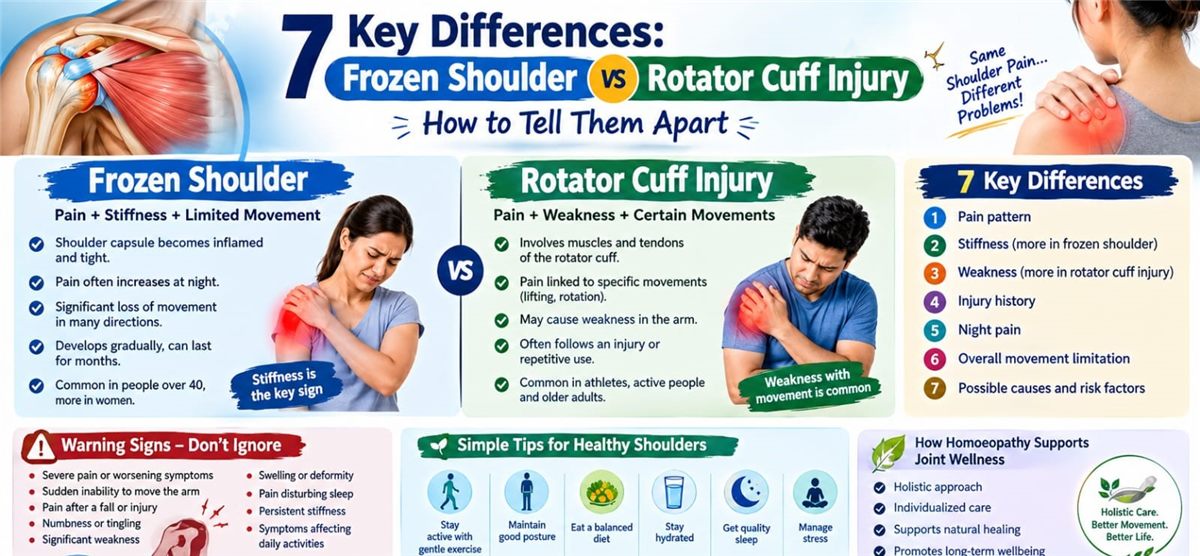
Frozen Shoulder vs Rotator Cuff Injury is a common point of confusion for people experiencing shoulder pain.Both conditions can make everyday activities difficult. Reaching for a shelf, wearing a shirt, combing your hair, or sleeping on one side may suddenly become uncomfortable. But there is an important difference. A frozen shoulder, also called adhesive capsulitis, mainly causes progressive pain and stiffness with a significant reduction in shoulder movement. A rotator cuff injury, on the other hand, involves the muscles and tendons that help lift and rotate the arm. A rotator cuff problem can cause pain, weakness and difficulty with certain movements.
Knowing these differences is useful because shoulder pain should not simply be ignored or self-diagnosed.
🔎 Frozen Shoulder vs Rotator Cuff Injury: What Is the Difference?
Let’s understand both conditions in simple words.
🧊 What is Frozen Shoulder?
Frozen shoulder happens when the capsule surrounding the shoulder joint becomes inflamed and gradually tightens.
The result is pain followed by increasing stiffness.
People may notice that movements which were previously easy become difficult.
For example:
🙋 Raising the arm becomes difficult
👕 Putting on a shirt becomes uncomfortable
💇 Combing your hair becomes harder
🙌 Reaching behind your back becomes difficult
😴 Sleeping on the painful side may become uncomfortable
Frozen shoulder often develops gradually and can progress through painful, stiff and recovery phases. Recovery can take months and sometimes longer.
💪 What Is a Rotator Cuff Injury?
The rotator cuff is a group of muscles and tendons that help stabilize the shoulder and allow you to lift and rotate your arm. An injury can involve irritation, degeneration or a partial or complete tendon tear. Rotator cuff problems may occur because of repeated overhead activity, gradual age-related tendon changes, or an injury such as a fall. Pain may become noticeable when reaching overhead, lifting objects or using the affected arm. Weakness can also be an important feature.
1️⃣ Pain Pattern Can Be Different
One of the first clues is how the pain behaves.
With frozen shoulder, pain can develop gradually and may become particularly troublesome at night. The pain is often followed by increasing stiffness.
With a rotator cuff injury, pain may be more closely related to certain movements, especially lifting or rotating the arm.
However, there can be considerable overlap.
👉 This is why pain location alone cannot confirm the diagnosis.
2️⃣ Stiffness Is a Major Clue in Frozen Shoulder 🧊
A major feature of frozen shoulder is a significant loss of shoulder movement.
You may feel as if your shoulder has become “stuck.”
Even simple movements can become difficult.
For example:
– Reaching behind your back
– Putting your hand behind your head
– Lifting your arm
– Rotating your arm outward
– Putting on or removing clothes
Frozen shoulder typically restricts several directions of shoulder movement rather than only causing pain during one particular activity. Also read 🌅 Morning Stiffness कब Arthritis का Signal होता है? – जानिए जरूरी संकेत
3️⃣ Weakness May Point Toward a Rotator Cuff Problem 💪
Weakness is an important symptom to notice. If your shoulder hurts and you also feel that your arm has genuinely become weaker, a rotator cuff problem may need to be considered. For example, you might find it difficult to:
🏋️ Lift an object
🙋 Raise your arm overhead
🧳 Carry a bag
🧹 Perform repetitive household work
👕 Put on clothes
Rotator cuff tears can weaken the shoulder and make activities such as dressing or combing the hair difficult.
But weakness can have other causes too, so it should be properly evaluated.
4️⃣ Did the Pain Start After an Injury? 🚨
Think about what happened before the pain started.
Did you:
– Fall on your shoulder?
– Lift something suddenly?
– Pull something forcefully?
– Play an overhead sport?
– Experience a sudden shoulder injury?
A sudden injury followed by significant pain or weakness can raise concern about a rotator cuff injury or another shoulder problem.
Frozen shoulder can also occur after an injury or period of reduced shoulder movement, but it often develops gradually without one obvious injury.
Also read 🦵 Knee Pain While Climbing Stairs – Early Warning Sign You Should Not Ignore
5️⃣ Night Pain Can Occur in Both Conditions 🌙
Night pain can make shoulder problems especially frustrating.
Frozen shoulder commonly causes pain that becomes worse at night and can disturb sleep.
Rotator cuff-related shoulder problems can also cause night discomfort, particularly when lying on the affected side.
Therefore:
❌ Night pain alone does not prove that you have frozen shoulder.
The overall pattern of pain, stiffness, weakness and movement restriction matters more.
6️⃣ Frozen Shoulder Usually Limits Overall Movement
This is one of the most useful differences when comparing Frozen Shoulder vs Rotator Cuff Injury.
With frozen shoulder, you may find that many shoulder movements are restricted.
The problem isn’t simply that one particular movement hurts.
The shoulder itself may feel increasingly stiff.
With rotator cuff problems, some movements may be much more painful or difficult than others, particularly movements involving lifting or rotation.
Still, there is significant overlap between shoulder conditions, so a physical examination is often needed to distinguish them accurately.
7️⃣ The Cause Can Give You Important Clues 🔍
Frozen shoulder can sometimes occur without an obvious cause. It can also develop after an injury, surgery or prolonged lack of shoulder movement. Certain health conditions, including diabetes and thyroid disorders, are associated with a higher risk. Rotator cuff problems can be associated with:
💪 Repetitive overhead activity
🏃 Sports-related stress
🧓 Age-related tendon changes
🤕 Falls or sudden injuries
🔁 Repeated shoulder strain
Age-related changes in the rotator cuff are common, and not every tear necessarily causes symptoms.
🩺 How Is Frozen Shoulder vs Rotator Cuff Injury Diagnosed?
You should not try to diagnose yourself only from symptoms.
A healthcare professional may ask:
– When did the pain begin?
– Was there an injury?
– Is the pain worse at night?
– Which movements are difficult?
– Is your shoulder stiff?
– Do you feel weakness?
– Can you lift your arm normally?
The shoulder can then be examined to assess movement, strength and pain patterns.
Depending on the situation, imaging such as an X-ray, ultrasound or MRI may be considered. For suspected rotator cuff tears, clinical examination combined with imaging can improve diagnostic accuracy.
⚠️ When Should You Not Ignore Shoulder Pain?
Please seek medical evaluation if:
🚨 Shoulder pain is severe or worsening
🚨 You suddenly cannot move your arm
🚨 Pain began after a fall or significant injury
🚨 Your shoulder or arm looks deformed or badly swollen
🚨 You have persistent numbness or pins and needles
🚨 You notice significant weakness
🚨 Pain continues and interferes with sleep or daily activities
🚨 Shoulder stiffness keeps getting worse
Sudden severe shoulder pain, inability to move the arm, deformity or symptoms following an injury can require urgent assessment.
🌿 Can Lifestyle Habits Help Protect Your Shoulders?
Your shoulders are designed to move.
Long periods of inactivity, poor posture and repetitive movements can contribute to shoulder discomfort.
Some simple habits can help support shoulder health:
🧘 Keep Moving Gently
Avoid keeping the shoulder completely still for long periods unless a healthcare professional has specifically advised you to do so. Gentle movement within comfortable limits can help maintain mobility.
💻 Improve Your Work Posture
If you spend long hours at a desk:
✔️ Keep your screen at a comfortable height
✔️ Avoid rounding your shoulders
✔️ Take regular movement breaks
✔️ Avoid keeping your neck and shoulders tense for long periods
🏋️ Avoid Sudden Overloading
Don’t suddenly increase heavy lifting or overhead exercise.
Give your muscles and tendons time to adapt.
😴 Pay Attention to Sleep Position
If lying directly on the painful shoulder increases discomfort, changing your sleeping position may help reduce pressure.
🌿 What About Homoeopathy and Shoulder Health?
As a Homoeopathic Consultant, I focuses on understanding the individual, their symptoms, lifestyle and overall health.However, shoulder pain, stiffness or weakness should first be properly evaluated to understand the underlying cause.Homoeopathy should not be presented as a substitute for appropriate medical assessment, physiotherapy, imaging or specialist care when these are indicated.The important first step is understanding what is actually causing your shoulder problem.
❤️ Final Thoughts: Frozen Shoulder vs Rotator Cuff Injury
Frozen Shoulder vs Rotator Cuff Injury can be difficult to distinguish because both can cause shoulder pain and difficulty with everyday activities.
Remember these simple clues:
🧊 Frozen shoulder: prominent stiffness and progressively restricted movement.
💪 Rotator cuff problem: pain with certain movements and possible weakness, particularly after injury or repetitive shoulder use. But these clues are not enough to make a diagnosis. If your shoulder pain is persistent, worsening, associated with weakness, or significantly restricting movement, don’t simply wait for it to disappear. Early evaluation can help identify the problem and guide appropriate care. 🩺
👨⚕️ Dr. Rajendra Shrimali, MD (Homoeo.)
Homoeopathic Consultant
🏥 Dr. Shrimali’s Homoeopathic Multispecialty Clinic
📍 1st Floor, Court Road, Kopargaon, Dist. Ahilyanagar (MH)
📞 Phone: 7666360940
📸 Instagram: @dr.rajendra_shrimali
Dr. Rajendra Shrimali, MD (Homoeo.)
Homoeopathic Consultant, Dr. Shrimali's Homoeopathic Multispecialty Clinic, Kopargaon.