7 Signs of Hip Pain in Runners: When to Rest and When to Seek Treatment
Hip Pain in Runners: When Should You Rest? Hip
🏃 Hip Pain in Runners: When Should You Rest?
Hip Pain in Runners can be frustrating.
You may have been running regularly for months or even years without any problem. Then suddenly, you notice discomfort in your hip while running.
At first, it may be a small ache.
You may think:
“I probably just need to stretch.”
So you continue running.
But the pain returns the next day.
This is where runners need to pay attention.
Not every hip pain means a serious injury. Sometimes your body simply needs recovery. But persistent or worsening pain can indicate an underlying problem that needs proper evaluation.
🦵 The important question is not just “Why does my hip hurt?” but also “When should I stop running and get it checked?”
As a doctor practising Homoeopathy, I always encourage people to understand their symptoms instead of repeatedly pushing through pain.
🦴 What Can Cause Hip Pain in Runners?
Running places repeated stress on the hips, knees, ankles and feet.
Several factors can contribute to hip pain, including:
- 🏃 Increasing running distance too quickly
- ⚡ Sudden increase in running speed or intensity
- 🧘 Poor flexibility
- 💪 Weakness of supporting muscles
- 👟 Unsuitable or worn-out footwear
- 🛣️ Repeated running on certain surfaces
- 🩹 Previous injuries
- 😴 Inadequate recovery
- 🔄 Repetitive overuse
Sometimes the pain comes from muscles or tendons around the hip.
In other cases, the hip joint itself may be involved.
There can also be problems involving the lower back that cause pain to be felt around the hip.
This is why the exact cause should not be assumed simply because you are a runner.
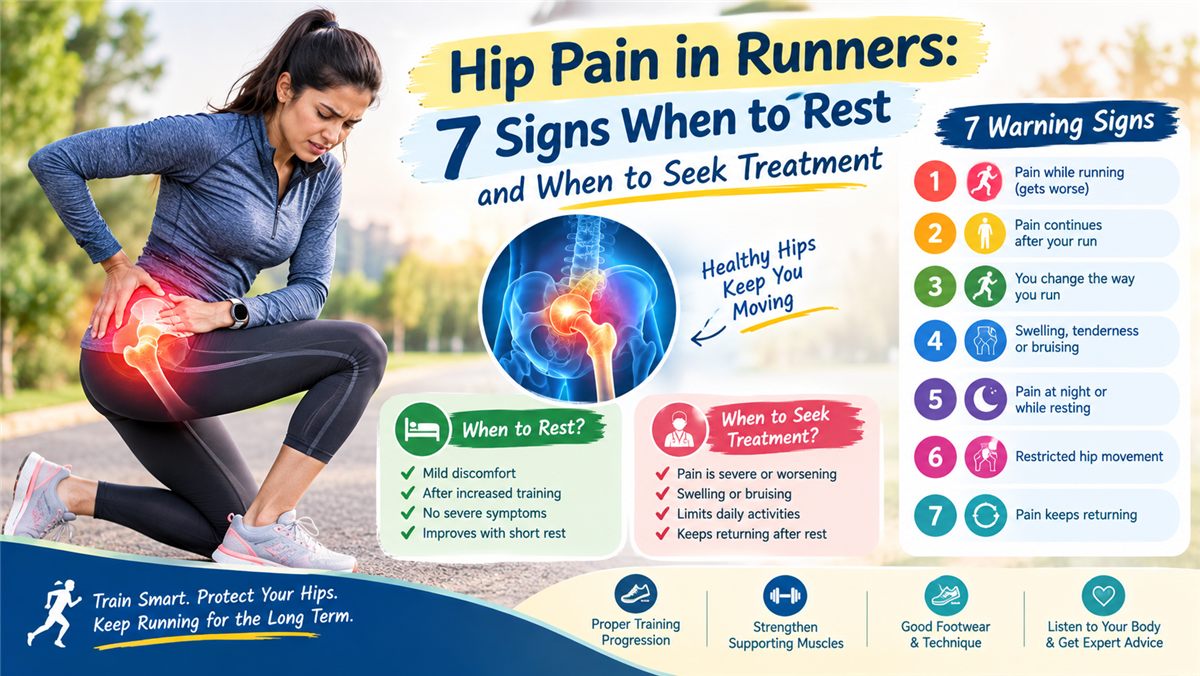
⚠️ Hip Pain in Runners: 7 Signs You Should Not Ignore
1️⃣ Pain That Gets Worse While Running
A little muscle soreness after a new workout can happen.
But if your hip pain consistently becomes worse as you continue running, that is a warning sign.
For example, you may start your run feeling comfortable but notice increasing pain after a few kilometres.
Some runners try to “run through” this discomfort.
That is not always a good idea.
👉 If pain is increasing during the activity, stop and assess what your body is telling you.
2️⃣ Hip Pain That Continues After Your Run
Another important sign is pain that does not settle after exercise.
You may finish your run and notice:
- Pain while walking
- Difficulty climbing stairs
- Discomfort when sitting
- Pain while getting out of a chair
- Aching later in the evening
If the pain repeatedly remains after your workouts, your body may need more than just a few minutes of stretching.
A temporary reduction in activity may be appropriate, and persistent symptoms should be professionally assessed.
3️⃣ You Start Changing the Way You Run 🏃♀️
This is something many runners overlook.
When a particular movement hurts, your body naturally tries to protect the painful area.
You may start:
- Limping
- Taking shorter steps
- Tilting your body
- Avoiding one side
- Changing your running pattern
This is called compensation.
The problem is that changing your natural movement can place additional stress on other joints and muscles.
If you notice yourself changing the way you run because of hip pain, don’t simply continue training at the same intensity.
4️⃣ There Is Swelling, Significant Tenderness or Bruising
Visible swelling or bruising deserves attention.
These symptoms may occur after an injury and can indicate that the tissues around the hip have been affected.
If pain begins suddenly after:
🏃 A fall
🏃 A collision
🏃 A sudden change in direction
🏃 An awkward landing
🏃 An intense workout
it is better to stop running and have the injury assessed if symptoms are significant or do not improve.
5️⃣ You Have Pain at Night or While Resting 🌙
Most runners understand that discomfort after a hard training session can happen.
But pain that continues when you are resting or repeatedly disturbs your sleep should not simply be blamed on exercise.
Night pain can have several causes.
It does not automatically mean something serious, but persistent pain at rest deserves medical attention.
6️⃣ Your Hip Movement Becomes Restricted
Have you noticed that you cannot move your hip as freely as before?
Perhaps:
- Getting into a car has become uncomfortable.
- You find it difficult to put on your shoes.
- Squatting feels restricted.
- You cannot comfortably cross your legs.
- Certain movements cause sharp pain.
A change in hip mobility can be an important clue.
Don’t force the joint through painful movements just to maintain your normal exercise routine.
7️⃣ The Pain Keeps Returning
This is perhaps one of the most important signs.
You rest for a few days.
The pain improves.
You start running again.
The pain returns.
Then you repeat the same cycle.
🔄 Pain → Rest → Improvement → Running → Pain again.
This pattern should make you pause.
Recurring pain may mean that the underlying problem has not been addressed.
Instead of repeatedly resting and restarting the same training routine, consider getting the cause evaluated.
🧘 Hip Pain in Runners: When Is Rest Reasonable?
If the pain is mild and clearly related to increased training, reducing activity may allow your body to recover.
For example, if you recently:
🏃 Increased your running distance
⚡ Started sprint training
⛰️ Added hill running
📅 Increased training frequency
your body may need more recovery time.
During this period, avoid activities that clearly increase the pain.
Gentle movement that does not cause pain may be appropriate for some people, but the right level of activity depends on the underlying problem.
Rest should not mean ignoring the problem.
If symptoms keep returning, evaluation is important.
🚨 When Should You Seek Treatment for Hip Pain?
You should consider professional medical evaluation when:
🔴 Pain is severe or rapidly worsening
🔴 You cannot comfortably walk or put weight on the leg
🔴 There was a significant injury
🔴 There is considerable swelling or bruising
🔴 Pain repeatedly wakes you at night
🔴 Hip movement is becoming increasingly restricted
🔴 You develop weakness or numbness
🔴 The pain keeps returning after rest
🔴 Your running pattern has changed because of pain
A healthcare professional can assess the symptoms and determine whether further examination or investigations are needed.
👟 How Can Runners Reduce the Risk of Hip Problems?
🏃 Increase Training Gradually
Don’t suddenly double your running distance because you feel energetic.
Give your body time to adapt.
Gradual progression is particularly important after a long break from exercise.
💪 Strengthen Supporting Muscles
Running is not only about strong legs.
The muscles around your hips, pelvis and core also contribute to movement and stability.
A balanced exercise programme can help support good running mechanics. Also Read 7 Signs of Osteoarthritis in Gym-Goers: Are You Overtraining Your Joints? 🏋️♂️🦵
🧘 Don’t Forget Warm-Up and Recovery
Before intense running, prepare your body with appropriate warm-up activities.
After training, allow enough recovery time.
Sleep, nutrition and rest are all part of training—not obstacles to it.
👟 Check Your Footwear
Your shoes should be appropriate for your running activity and fit comfortably.
If your shoes are significantly worn or uncomfortable, they may be worth replacing.
However, footwear alone does not explain every case of hip pain.
🏃♂️ Should You Stop Running Completely?
Not necessarily.
The answer depends on the cause and severity of the pain.
Some runners may need a temporary break from running.
Others may be able to modify their training under professional guidance.
The important thing is not to make a blanket decision based only on the word “pain.”
Instead, understand:
Where is the pain?
When does it happen?
What makes it worse?
Does it disappear with rest?
Does it return when you start running again?
These details can help a healthcare professional understand the problem better.
🌿 Hip Pain in Runners and Homoeopathy
Homoeopathy takes an individualised approach and considers a person’s symptoms, lifestyle, activity level and overall wellbeing.
However, persistent hip pain—especially after an injury or when accompanied by significant movement restriction—should be properly assessed.
Homoeopathy should not be used as a reason to delay necessary medical evaluation, investigations, rehabilitation or specialist care.
The priority should always be understanding the cause of the pain and choosing appropriate care.
❤️ A Doctor’s Advice for Runners
After 3 decades of clinical practice, my advice to runners is simple:
Don’t treat pain as a test of your toughness.
Running is an excellent form of physical activity.
But being a good runner does not mean ignoring every warning signal from your body.
🏃 Train consistently.
🧘 Recover properly.
💪 Build supporting strength.
👂 Listen to your body.
🩺 Get persistent symptoms checked.
A few days of appropriate recovery may be very different from repeatedly running through pain and allowing a small problem to become a bigger one.
Your goal should not only be to run farther.
Your goal should also be to keep running safely for years to come.
📌 Final Thoughts on Hip Pain in Runners
Hip Pain in Runners can have many causes, from temporary muscle soreness and training overload to injuries or problems involving the hip joint.
Mild discomfort after a change in training may improve with appropriate rest.
But pain that becomes worse while running, changes your running pattern, limits movement, occurs at rest or repeatedly returns should not be ignored.
🦵 Rest when your body needs recovery.
🩺 Seek professional advice when symptoms persist or become concerning.
🏃 And remember—smart training is not about pushing through every pain. It is about knowing when to listen to your body.
📍 Clinic Details
👨⚕️ Dr. Rajendra Shrimali, MD (Homoeo.)
Homoeopathic Consultant
🏥 Dr. Shrimali’s Homoeopathic Multispecialty Clinic
1st Floor, Court Road, Kopargaon, Dist. Ahilyanagar (MH)
📞 Phone: 7666360940
📸 Instagram: @dr.rajendra_shrimali
Dr. Rajendra Shrimali, MD (Homoeo.)
Homoeopathic Consultant, Dr. Shrimali's Homoeopathic Multispecialty Clinic, Kopargaon.