Knee Pain Without Swelling: 7 Common Causes You Should Know
Knee Pain Without Swelling can be confusing. Many people expect

Knee Pain Without Swelling can be confusing. Many people expect a knee problem to cause visible swelling, redness, or warmth. But that is not always the case.
A person may have pain while climbing stairs, getting up from a chair, walking, squatting, or sitting for a long time—even when the knee looks completely normal from the outside.
In my 3 decades of clinical practice as a Homoeopathic Consultant, I have seen many patients who initially ignored knee pain simply because there was no swelling. However, pain is itself an important signal from the body and should not always be dismissed.
The good news is that knee pain without swelling does not necessarily mean something serious. There can be several possible reasons, from muscle weakness and overuse to age-related joint changes.
Let us understand some common causes. 👇
What Does Knee Pain Without Swelling Mean? 🤔
Knee Pain Without Swelling means discomfort in or around the knee without obvious puffiness or visible inflammation.
The pain may be:
- Mild and occasional
- Present only during movement
- Worse while climbing stairs
- More noticeable after sitting for a long time
- Felt while standing up
- Associated with stiffness
- Present after exercise or physical activity
- A dull, aching, or sometimes sharp sensation
The location of the pain can also provide useful clues.
Pain in the front of the knee may have different causes from pain at the inner, outer, or back portion of the knee.
This is why simply looking at the knee is not enough. A proper assessment considers your age, activity level, lifestyle, previous injuries, posture, muscle strength and the exact nature of the pain.
1. Knee Pain Without Swelling Due to Overuse 🏃
One of the common reasons for Knee Pain Without Swelling is simply doing too much.
You may increase your walking suddenly, start exercising after a long break, spend more time climbing stairs, or begin a new sport.
The knee repeatedly absorbs and transfers load during these activities. If the body does not get enough time to adjust, discomfort can develop.
You may notice pain:
🔹 After a long walk
🔹 After exercising
🔹 While climbing stairs
🔹 After repeated squatting
🔹 After standing for several hours
Usually, the history of recent activity is an important clue.
👉 If your knee pain started after a sudden increase in physical activity, do not ignore the connection.
2. Muscle Weakness Around the Knee 💪
The knee does not work alone.
The muscles of the thigh, hip and lower leg help support and control knee movement. When these muscles are weak or not working efficiently, the knee may have to handle more stress during everyday activities.
This can happen in people who:
Sit for long hours
Have a sedentary lifestyle
Have recently stopped exercising
Are recovering from an injury
Have poor overall muscle conditioning
In such cases, the knee may hurt without showing any visible swelling.
🪑 Spending eight or more hours sitting every day can also contribute to reduced muscle activity and stiffness.
Regular, appropriate movement is an important part of maintaining healthy joints and muscles.
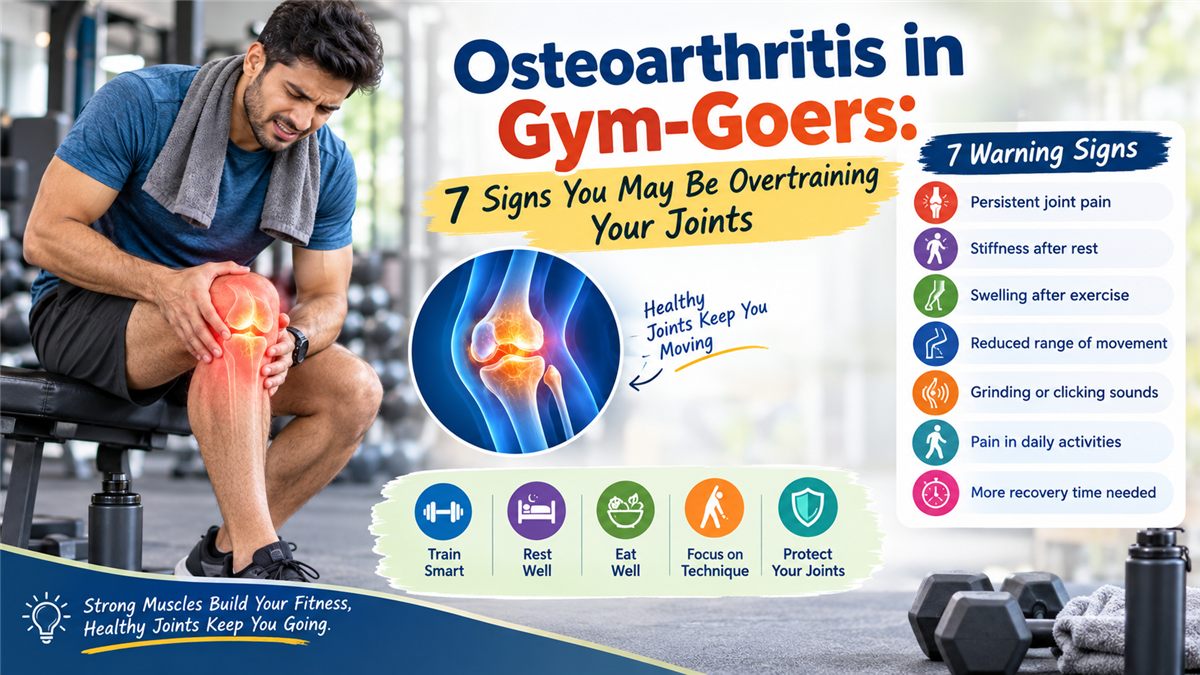
3. Early Osteoarthritis Can Cause Knee Pain Without Swelling 🦴
Many people associate arthritis with swollen joints.
But Knee Pain Without Swelling can sometimes occur with early or mild osteoarthritis.
Osteoarthritis involves changes in the tissues and structures of a joint over time. The symptoms can develop gradually.
A person may experience:
🦵 Pain while walking
🪜 Difficulty climbing or descending stairs
🪑 Discomfort after sitting for a long time
🌅 Stiffness after getting up
🚶 Pain after prolonged activity
Not everyone with osteoarthritis has obvious swelling.
Age is one factor, but knee joint problems are not limited only to older adults. Previous injuries, body weight, physical workload and other factors can also influence joint health.
4. Patellofemoral Pain Can Cause Knee Discomfort 🎯
The kneecap, or patella, moves over the front part of the knee during activities such as walking, running, climbing stairs and squatting.
Sometimes, the movement between the kneecap and the surrounding structures can become painful.
This is commonly described as patellofemoral pain.
A person may notice:
🔸 Pain at the front of the knee
🔸 Discomfort while climbing stairs
🔸 Pain during squats
🔸 Pain after sitting with the knees bent for a long time
🔸 Discomfort while getting up from a chair
There may be no visible swelling.
This is one reason why the absence of swelling should not be used as proof that the knee is completely healthy.
5. Previous Knee Injury Can Remain a Problem ⚠️
Did you injure your knee months or even years ago?
A previous injury can sometimes continue to influence how the knee moves.
For example, after an injury, a person may unconsciously change the way they walk or put weight on the leg. Muscles may also become weaker because activity was reduced during recovery.
As a result, discomfort may continue or return even when there is no swelling.
Previous injuries that deserve attention include:
- Sports injuries
- Twisting injuries
- Falls
- Ligament injuries
- Meniscus-related problems
- Previous knee surgery
🩺 If your current knee pain is occurring around the site of an old injury, mention that history during your medical consultation.
6. Hip, Foot or Posture Problems May Affect the Knee 👣
Sometimes the source of knee discomfort is not limited to the knee itself.
The hip, ankle and foot work together as a functional chain.
Changes in foot position, walking pattern, hip strength or overall posture can alter the way force travels through the lower limb.
For example, someone with an altered walking pattern may repeatedly place stress on one part of the knee.
Similarly, weakness around the hip can affect lower-limb movement during activities such as running, walking and climbing stairs.
This is why a good evaluation should not focus only on the painful spot.
👨⚕️ Sometimes understanding how the entire leg moves gives us more information than looking at the knee alone.
7. Nerve-Related or Referred Pain Can Feel Like Knee Pain ⚡
Not every pain felt around the knee originates directly from the knee joint.
Problems involving the lower back, hip or nerves can sometimes cause pain that is felt further down the leg.
You may experience:
⚡ Burning or shooting pain
⚡ Tingling or numbness
⚡ Pain travelling down the leg
⚡ Back pain along with leg discomfort
⚡ Changes in sensation
This type of pain may not cause swelling around the knee.
Therefore, if knee pain is associated with unusual sensations such as numbness, tingling or weakness, it deserves proper medical assessment.
Knee Pain Without Swelling: When Should You See a Doctor? 🩺
Not every episode of knee discomfort requires immediate medical attention.
However, you should consider professional evaluation when:
🚨 Pain persists or keeps returning
🚨 Pain is getting progressively worse
🚨 You have difficulty walking
🚨 The knee feels unstable or gives way
🚨 You cannot fully bend or straighten the knee
🚨 Pain is disturbing your sleep
🚨 Pain follows a significant injury
🚨 You have unexplained weakness or numbness
🚨 Daily activities are becoming difficult
A doctor may assess your walking pattern, knee movement, muscle strength, previous injuries and other relevant factors.
Depending on the situation, further investigations may sometimes be recommended.
What Can You Do for Knee Pain Without Swelling? 🌿
The first step is understanding what may be causing the pain.
Until the cause is clear, avoid repeatedly pushing through significant pain.
Some general habits can support healthy knees:
🚶 Keep Moving
Complete inactivity can contribute to stiffness and reduced muscle strength. Choose comfortable, appropriate movement according to your individual condition.
⚖️ Maintain a Healthy Weight
Excess body weight can increase the mechanical load placed on weight-bearing joints such as the knees.
🪑 Avoid Long Periods of Sitting
If your work involves sitting for long hours, take regular movement breaks.
🏃 Increase Exercise Gradually
Avoid suddenly going from very little activity to intense workouts.
👟 Pay Attention to Footwear
Comfortable footwear can help support normal movement during everyday walking and activity.
🩺 Do Not Self-Diagnose for Too Long
If knee pain keeps returning, finding the underlying reason is more useful than simply ignoring it because there is no swelling.
Knee Pain Without Swelling: What Should You Remember? 📝
Knee Pain Without Swelling is still worth paying attention to.
The absence of swelling does not tell us exactly what is happening inside or around the knee.
The possible causes can include:
✅ Overuse
✅ Muscle weakness
✅ Early osteoarthritis
✅ Patellofemoral pain
✅ Previous injury
✅ Foot, hip or posture-related problems
✅ Referred or nerve-related pain
The important thing is not to become unnecessarily worried—but also not to ignore persistent symptoms.
Every person’s knee is different. The cause of pain depends on the individual’s age, activity, medical history, movement pattern and other factors.
👨⚕️ A Doctor’s Message
When patients tell me, “Doctor, there is no swelling, so I thought it was nothing,” I remind them that pain does not always come with visible changes.
Your body can give you an early warning through discomfort.
If your knee hurts occasionally after an unusually active day, observing it and allowing appropriate recovery may be reasonable. But if the pain is persistent, repeatedly returning, or affecting your normal activities, it is better to understand the reason.
After 3 decades of clinical practice, my advice is simple:
Listen to your body. Keep your joints active. Avoid unnecessary strain. And do not ignore persistent pain simply because there is no swelling. ❤️🦵
👨⚕️ Dr. Rajendra Shrimali, MD (Homoeo.)
Homoeopathic Consultant
🏥 Dr. Shrimali’s Homoeopathic Multispecialty Clinic
1st Floor, Court Road, Kopargaon, Dist. Ahilyanagar (MH)
📞 Phone: 7666360940
📸 Instagram: @dr.rajendra_shrimali
Dr. Rajendra Shrimali, MD (Homoeo.)
Homoeopathic Consultant, Dr. Shrimali's Homoeopathic Multispecialty Clinic, Kopargaon.