7 Signs of Osteoarthritis in Gym-Goers: Are You Overtraining Your Joints?
Osteoarthritis in Gym-Goers: Is Your Workout Helping or Hurting
🏋️ Osteoarthritis in Gym-Goers: Is Your Workout Helping or Hurting Your Joints?
Osteoarthritis in Gym-Goers may sound surprising.
After all, exercise is usually considered good for the body.
And yes, regular physical activity is important for maintaining muscle strength, mobility and overall health. But there is a difference between healthy exercise and repeatedly overloading a joint without enough recovery.
Some gym-goers train hard every day because they want faster results. They increase weights, repeat the same movements or continue exercising despite pain.
Over time, this can place considerable stress on certain joints.
🦵 Your muscles may become stronger, but your joints also need recovery.
The important question is not whether exercise is good or bad.
The real question is:
Are you giving your joints the right amount of exercise, recovery and protection?
🦴 What Is Osteoarthritis?
Osteoarthritis is a condition in which the tissues within a joint gradually undergo changes over time.
It commonly affects weight-bearing joints such as:
- 🦵 Knees
- 🦶 Hips
- 🖐️ Hands
- 🦴 Spine
The condition can cause pain, stiffness and difficulty with movement.
Osteoarthritis is more common with increasing age, but age is not the only factor.
Previous joint injuries, repeated stress, body weight, muscle weakness and other factors can also influence joint health.
This is why Osteoarthritis in Gym-Goers deserves attention. Also read Difference between Arthritis vs Osteoarthritis
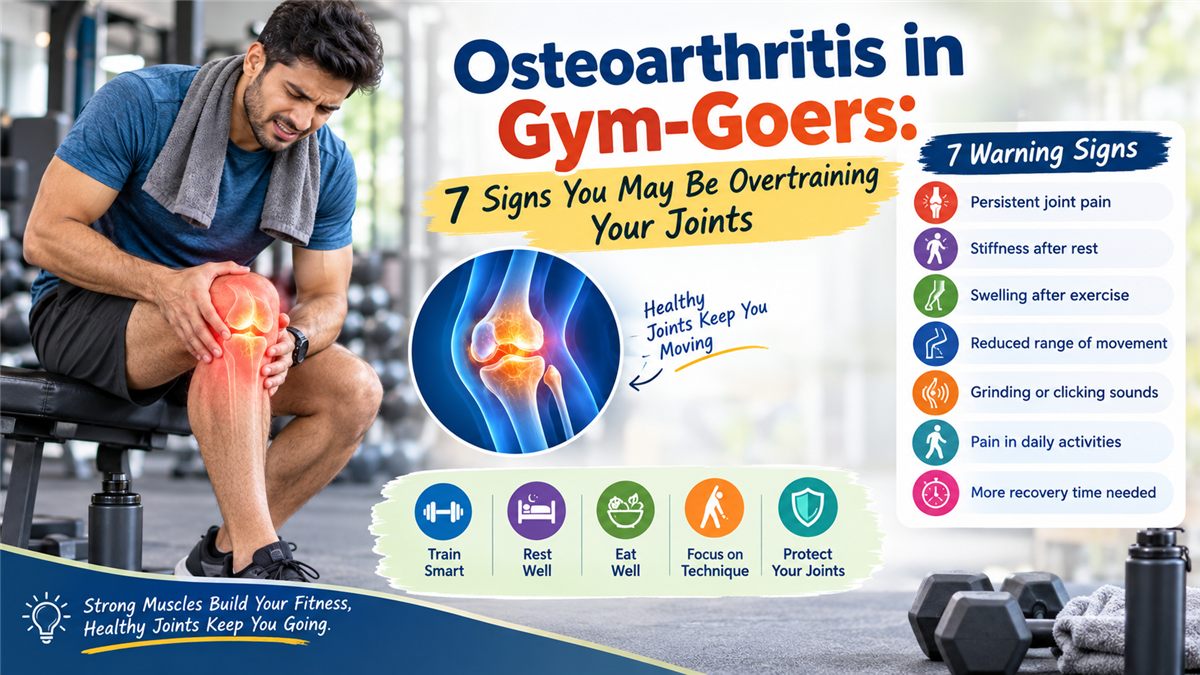
⚠️ Osteoarthritis in Gym-Goers: 7 Warning Signs
1️⃣ Joint Pain That Keeps Returning
Some muscle soreness after exercise is normal.
But joint pain that repeatedly returns after workouts deserves more attention.
For example, you may notice:
- Knee pain after squats
- Hip pain after leg exercises
- Pain while climbing stairs
- Discomfort after running
- Pain that appears after increasing your workout intensity
👉 If the same joint keeps hurting after similar exercises, don’t simply assume that it is ordinary workout soreness.
2️⃣ Stiffness After Rest
Do your knees or other joints feel stiff when you get up after sitting for a while?
Or perhaps you experience stiffness when you wake up in the morning?
Joint stiffness can occur for many reasons, but persistent stiffness along with pain or reduced movement should not be ignored.
A gym-goer may sometimes focus so much on muscle recovery that they forget to pay attention to joint stiffness.
🧘 Your body gives you signals for a reason.
3️⃣ Swelling After Exercise
Swelling around a joint can be a sign that something needs attention.
You may notice that your knee becomes slightly swollen after:
🏋️ Heavy squats
🏃 Running
🦵 Lunges
🚴 Cycling
⚡ High-intensity workouts
Repeated swelling is not something you should simply train through.
If swelling continues or is accompanied by significant pain, medical evaluation may be appropriate.
4️⃣ Reduced Range of Movement
Another possible warning sign is difficulty moving a joint as freely as before.
For example:
- You cannot bend your knee comfortably.
- Squats become difficult.
- You struggle to fully straighten a joint.
- Certain exercises suddenly feel restricted.
- Your usual flexibility has decreased.
A reduction in movement may have several causes, including injury, inflammation, muscle tightness or joint changes.
The reason needs to be understood rather than assumed.
5️⃣ Grinding, Clicking or Crackling Sounds
Have you noticed unusual sounds from your knees while bending or exercising?
Some clicking and cracking sounds can occur even in healthy joints and may not necessarily indicate a serious problem.
However, when joint sounds occur together with:
❗ Pain
❗ Swelling
❗ Stiffness
❗ Reduced movement
they deserve more attention.
Don’t panic because of a sound alone.
Instead, look at the complete picture.
6️⃣ Pain During Everyday Activities
This is an important point.
Joint problems are not only about what happens inside the gym.
If knee or hip discomfort starts affecting everyday activities such as:
🚶 Walking
🪜 Climbing stairs
🪑 Getting up from a chair
🚗 Getting in and out of a vehicle
🧎 Sitting down or standing up
it may be time to take the symptom seriously.
Your workout should improve your quality of life, not gradually make normal movements more difficult.
7️⃣ You Need More Recovery Time Than Before
One of the easiest things to overlook is recovery.
Earlier, you may have completed a hard workout and felt fine after a day or two.
Now, perhaps your joints remain uncomfortable for several days.
You may also notice that the same exercise causes more discomfort than before.
This doesn’t automatically mean osteoarthritis.
However, persistent pain and longer recovery periods are reasons to reassess your training routine.
🏋️♀️ Why Can Gym-Goers Develop Joint Problems?
🔥 1. Training Too Hard, Too Often
More exercise does not always mean better results.
If you continuously train the same joints without sufficient recovery, repetitive stress can accumulate.
For example, repeatedly performing high-impact or heavy-loading exercises without appropriate rest may place additional stress on the knees, hips or other joints.
🏋️ 2. Increasing Weight Too Quickly
Progressive training is common in the gym.
But increasing weights too quickly can place unnecessary stress on the body’s tissues.
Your muscles, tendons and joints all need time to adapt.
👉 Increase intensity gradually rather than trying to achieve a new personal record every session.
🦵 3. Poor Exercise Technique
Technique matters.
Incorrect form during exercises such as squats, lunges, deadlifts or jumps can change how forces are distributed through the body.
Even a good exercise can become problematic when performed incorrectly or with excessive load.
Working with a qualified fitness professional can help you understand proper technique.
🩹 Previous Injuries Can Matter Too
A previous knee, hip or other joint injury may influence future joint health.
Some gym-goers return to intense workouts as soon as the pain decreases.
But pain relief does not always mean complete recovery.
If an injury has changed your movement pattern, continuing to train heavily may place additional stress on other areas.
This is why proper rehabilitation and a gradual return to exercise are important.
🧠 Is Exercise Bad for Osteoarthritis?
No.
This is an important misunderstanding to clear up.
Appropriate physical activity can be an important part of maintaining strength, mobility and overall wellbeing for people with joint problems.
The issue is usually not simply “exercise or no exercise.”
It is about choosing appropriate activities, intensity and progression according to an individual’s condition.
A person with joint pain may need to modify certain exercises rather than stop all physical activity.
🛡️ How Can Gym-Goers Protect Their Joints?
1️⃣ Give Your Body Recovery Time
Rest is not laziness.
Recovery is part of training.
Allow your body enough time between demanding sessions, especially when the same joints are repeatedly involved.
2️⃣ Don’t Ignore Persistent Pain
There is an important difference between temporary muscle soreness and persistent joint pain.
If a particular movement repeatedly causes pain, stop and reassess rather than repeatedly pushing through it.
3️⃣ Focus on Technique
Good form can help you perform exercises more safely and efficiently.
If you are unsure about your technique, seek guidance from a qualified trainer or exercise professional.
4️⃣ Strengthen the Supporting Muscles
Strong muscles around the hips, knees and other joints can help support movement.
A balanced fitness programme should not focus only on appearance or lifting heavier weights.
Functional strength matters too. 💪
5️⃣ Maintain a Healthy Body Weight
For weight-bearing joints, maintaining a healthy body weight can reduce mechanical stress.
This is particularly relevant for the knees and hips.
Small improvements in lifestyle can sometimes make a meaningful difference to overall joint health.
🩺 When Should You See a Doctor?
Don’t wait until joint pain becomes severe.
Consider professional evaluation if you experience:
🔴 Persistent joint pain
🔴 Repeated swelling
🔴 Increasing stiffness
🔴 Difficulty walking
🔴 Reduced range of motion
🔴 Pain affecting daily activities
🔴 A history of significant joint injury
🔴 Symptoms that continue despite reducing training
A doctor can assess your symptoms and determine whether further examination or investigations are needed.
🌿 Osteoarthritis in Gym-Goers and the Role of Homoeopathy
Homoeopathy takes an individualised approach and considers a person’s symptoms, lifestyle, general health and overall wellbeing.
However, persistent joint pain should always be properly assessed.
Homoeopathy should not be used as a reason to ignore significant symptoms, delay necessary investigations or continue an exercise routine that is causing injury.
A responsible approach to joint health should include appropriate medical assessment, healthy lifestyle habits, suitable physical activity and adequate recovery.
❤️ A Doctor’s Advice for Gym-Goers
As a doctor practising Homoeopathy , I would encourage gym-goers to remember one simple principle:
Train your body, but don’t punish your joints.
🏋️ Exercise should make you stronger.
🧘 Recovery should help your body adapt.
🦵 Pain should be understood rather than ignored.
There is nothing wrong with working hard toward your fitness goals. But your long-term joint health should also be part of those goals.
You don’t need to stop exercising just because you experience occasional discomfort.
Instead, learn to recognise the difference between normal post-workout soreness and symptoms that deserve attention.
Your future self will thank you for taking care of your joints today. ❤️
📌 Final Thoughts on Osteoarthritis in Gym-Goers
Osteoarthritis in Gym-Goers can be influenced by several factors, including previous injuries, repetitive joint stress, excessive training, body weight and individual health conditions.
Exercise itself is not necessarily the problem.
The bigger concern is how you train, how often you train, how much load you use and whether you allow your body enough time to recover.
If you notice persistent pain, swelling, stiffness or reduced movement, don’t simply increase your training intensity and hope it disappears.
Listen to your body.
💪 Strong muscles are important. Healthy joints are important too.
📍 Clinic Details
👨⚕️ Dr. Rajendra Shrimali, MD (Homoeo.)
Homoeopathic Consultant
🏥 Dr. Shrimali’s Homoeopathic Multispecialty Clinic
1st Floor, Court Road, Kopargaon, Dist. Ahilyanagar (MH)
📞 Phone: 7666360940
📸 Instagram: @dr.rajendra_shrimali
Dr. Rajendra Shrimali, MD (Homoeo.)
Homoeopathic Consultant, Dr. Shrimali's Homoeopathic Multispecialty Clinic, Kopargaon.