Flat Feet in Children: 7 Important Facts Every Parent Should Know
Flat Feet in Children is a common concern among
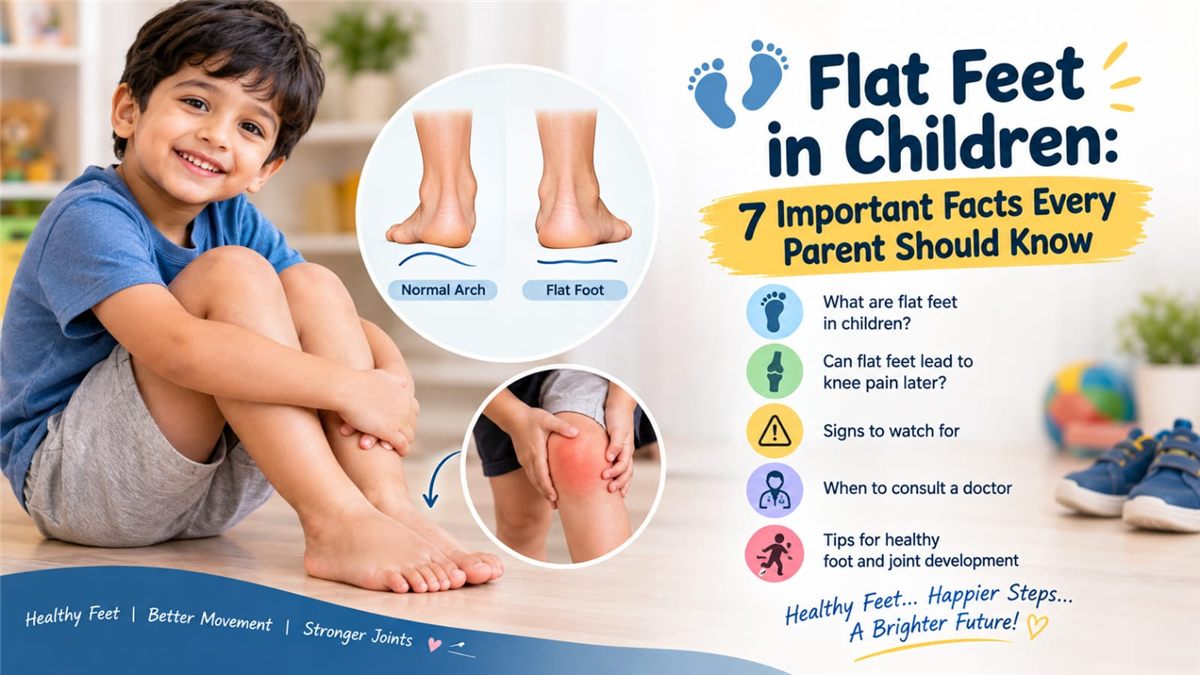
👣 Flat Feet in Children is a common concern among parents. Many parents notice that their child’s feet look flat when standing and immediately wonder, “Is something wrong?”
The good news is that flat feet are often a normal part of childhood development. However, in some children, changes in the way the foot touches the ground may affect the ankles, knees, hips, or even the way they walk.
One common question I hear from parents is: Can flat feet lead to knee pain later? 🤔
The answer is that there can be a connection, but flat feet do not automatically mean that a child will develop knee pain. It depends on several factors, including the child’s age, foot flexibility, walking pattern, posture, body weight, physical activity and whether there are other problems with the legs or joints.
Let us understand this in a simple way.
What Are Flat Feet in Children? 👣
Flat Feet in Children means that the natural arch on the inside of the foot appears low or is not clearly visible when the child is standing.
In young children, this can be completely normal. Babies and toddlers often have flatter-looking feet because their arches are still developing and because of the natural fat padding under their feet.
As children grow, the foot structure gradually develops. Some children continue to have flat feet even as they get older.
Flat feet can be:
– Flexible, where an arch appears when the child is sitting or standing on the toes
– Rigid, where the arch remains absent even when the foot is not bearing weight
– Associated with no symptoms at all
– Associated with pain, tiredness or changes in walking
👉 The appearance of the foot alone does not tell us whether there is a problem.
- Are Flat Feet Normal in Children? 😊
Yes, in many cases.
Children’s feet continue to develop during the early years of life. A visible arch may not be present in a young child, and this does not necessarily indicate a disease or weakness.
If your child runs, plays, walks and participates in normal activities without pain or difficulty, there may be no reason for immediate concern.
However, parents should pay attention when the child repeatedly complains about foot, ankle or leg discomfort.
- Can Flat Feet in Children Cause Knee Pain? 🦵
This is where parents often become concerned.
The feet are the foundation of the lower body. When we stand or walk, the movement of the feet influences the position and movement of the ankles and legs.
In some children with flat feet, the foot may roll inward excessively while walking. This can change the alignment and movement of the lower limb.
Over time, altered movement may place additional stress on areas such as:
– Ankles
– Shins
– Knees
– Hips
This does not mean that every child with flat feet will develop knee pain.
🩺 In fact, many children with flat feet remain completely comfortable and active.
The important point is to look at the whole child and the way the child moves, rather than focusing only on the shape of the foot.
Also read Homoeopathy for Children’s Immunity – Nurturing Natural Defenses Safely
- How Can Flat Feet Affect the Knees? 🔄
Think of the foot, ankle, knee and hip as a connected chain.
When the foot rolls inward more than usual during walking, the lower leg may also rotate inward. This can influence the way the knee moves.
For some children, this altered movement may contribute to discomfort, particularly during activities such as:
🏃 Running
⚽ Playing sports
🪜 Climbing stairs
🚶 Walking for long periods
🤸 Jumping or repeated physical activity
But remember—flat feet are only one possible factor behind knee pain in children.
Knee pain can have many other causes, including injuries, overuse, muscle imbalance, growth-related problems and other conditions.
- Signs of Flat Feet Parents Should Watch For 🔍
Most children with flexible flat feet do not have serious symptoms. Still, parents should observe their child’s movement.Look out for:
⚠️ Frequent complaints of foot or ankle pain
⚠️ Knee pain after running or playing
⚠️ A child avoiding physical activities
⚠️ Frequent tiredness while walking
⚠️ Difficulty keeping up with other children
⚠️ Frequent tripping or unusual walking patterns
⚠️ Shoes wearing out unevenly
⚠️ Swelling or persistent discomfort
⚠️ One foot looking significantly different from the other
If your child has persistent pain or difficulty with normal activities, it is better to get the child examined rather than assuming that flat feet are the only reason.
- When Should Parents Consult a Doctor? 👨⚕️
A doctor’s evaluation is especially useful when flat feet are associated with symptoms.
You should consider an assessment if:
🔹 Your child has persistent foot or knee pain
🔹 Pain is affecting sports or daily activities
🔹 The child frequently complains of tired legs
🔹 Walking appears significantly different
🔹 One foot is flatter than the other
🔹 The foot appears stiff or does not move normally
🔹 Symptoms are becoming more frequent
🔹 Your child suddenly develops pain after an injury
A proper evaluation may include looking at the child’s posture, walking pattern, foot movement, leg alignment and areas of discomfort.
Sometimes, simple observation is enough. In other situations, further assessment may be required.
- Should Parents Worry About Flat Feet in Children? ❤️
Not every flat foot needs treatment.
This is an important message for parents.
A child may have flat feet and still have healthy, active and pain-free movement. If there are no symptoms and the child’s development is normal, unnecessary worry may only create stress for the family.
Instead of asking only, “Does my child have flat feet?”, ask:
👉 Does my child have pain?
👉 Can my child run and play comfortably?
👉 Is the walking pattern normal?
👉 Is there difficulty with physical activities?
👉 Are both feet developing similarly?
These questions give a much clearer picture.
- Can Parents Help Protect Their Child’s Joint Health? 🌱
Parents can encourage healthy habits that support normal physical development.
👣 Encourage Regular Physical Activity
Children need movement. Running, walking, playing and age-appropriate sports help develop strength, balance and coordination.
⚖️ Maintain a Healthy Lifestyle
A balanced diet and regular activity are important for overall growth and healthy bones and joints.
👟 Pay Attention to Comfort
Children’s footwear should be comfortable and suitable for their activities. Avoid choosing shoes only because they look attractive.
🩺 Don’t Ignore Persistent Pain
Occasional tiredness after a very active day may not be unusual. But repeated or persistent pain deserves attention.
👀 Observe Walking Patterns
Parents know their children better than anyone. If you notice a new change in the way your child walks, runs or stands, discuss it with a healthcare professional.
Flat Feet in Children and Knee Pain: What Parents Should Remember 📝
The relationship between Flat Feet in Children and later knee pain is not as simple as saying “flat feet cause knee problems.”
👣 Flat feet are common during childhood.
😊 Many children with flat feet have no pain and remain completely active.
🦵 In some children, altered foot mechanics may influence the movement of the lower limb and may be associated with discomfort around the knees.
🔍 Persistent pain, unusual walking patterns or difficulty with activities should be evaluated.
❤️ Most importantly, parents should look at symptoms and function—not just the appearance of the feet.
As a Homoeopathic Consultant, I always encourage parents to understand their child’s individual health rather than becoming worried after noticing one physical feature.
Every child grows at a different pace. What matters is careful observation, timely evaluation when needed and supporting healthy physical development.
👨⚕️ A Final Message for Parents
Seeing flat feet in your child can naturally make you concerned about the future.
But there is no need to panic simply because an arch is not clearly visible. Flat Feet in Children can be a normal developmental finding, especially in younger children.
If your child is comfortable, active and developing normally, simply keep observing.
If there is persistent pain, difficulty walking, repeated complaints of knee or foot discomfort, or a noticeable change in movement, consult a qualified healthcare professional for an appropriate assessment. 🩺
Early attention to a child’s movement and comfort can help parents understand what is normal and what may need further evaluation.
👨⚕️ Dr. Rajendra Shrimali, MD (Homoeo.)
Homoeopathic Consultant
🏥 Dr. Shrimali’s Homoeopathic Multispecialty Clinic
1st Floor, Court Road, Kopargaon, Dist. Ahilyanagar (MH)
📞 Phone: 7666360940
📸 Instagram: @dr.rajendra_shrimali
Dr. Rajendra Shrimali, MD (Homoeo.)
Homoeopathic Consultant, Dr. Shrimali's Homoeopathic Multispecialty Clinic, Kopargaon.